Understanding the Problem
Premium seafood buyers had no reliable way to verify catch origin, cold-chain integrity, or distribution path. Trust was anecdotal — based on reputation — not evidenced. Restaurants and retailers couldn't differentiate on provenance because they couldn't prove it.
Context
- Premium seafood market in Hong Kong (85% premium pricing based on origin + freshness claims)
- Supply chain: 12+ touch points from boat to table (boat → ice plant → wholesaler → distributor → retailer → kitchen)
- Regulatory requirement: cold chain must stay ≤ -18°C with documented proof
- Competitive pressure: buyers wanted to claim 'origin verified' but had no system to prove it
Research InsightTransparency is a luxury, not a burden. When I talked to premium buyers, I expected them to view detailed provenance tracking as friction. Instead, they wanted MORE detail. 'If I can tell my customer exactly where this fish came from, what the temperature was every step, who touched it — that's the story I can charge premium pricing for.' Detailed provenance isn't noise to hide — it's proof to celebrate.
How I Tackled It
Transparency is a competitive advantage, not a compliance burden. When every actor in the chain has incentive to verify, the system's credibility strengthens through participation.
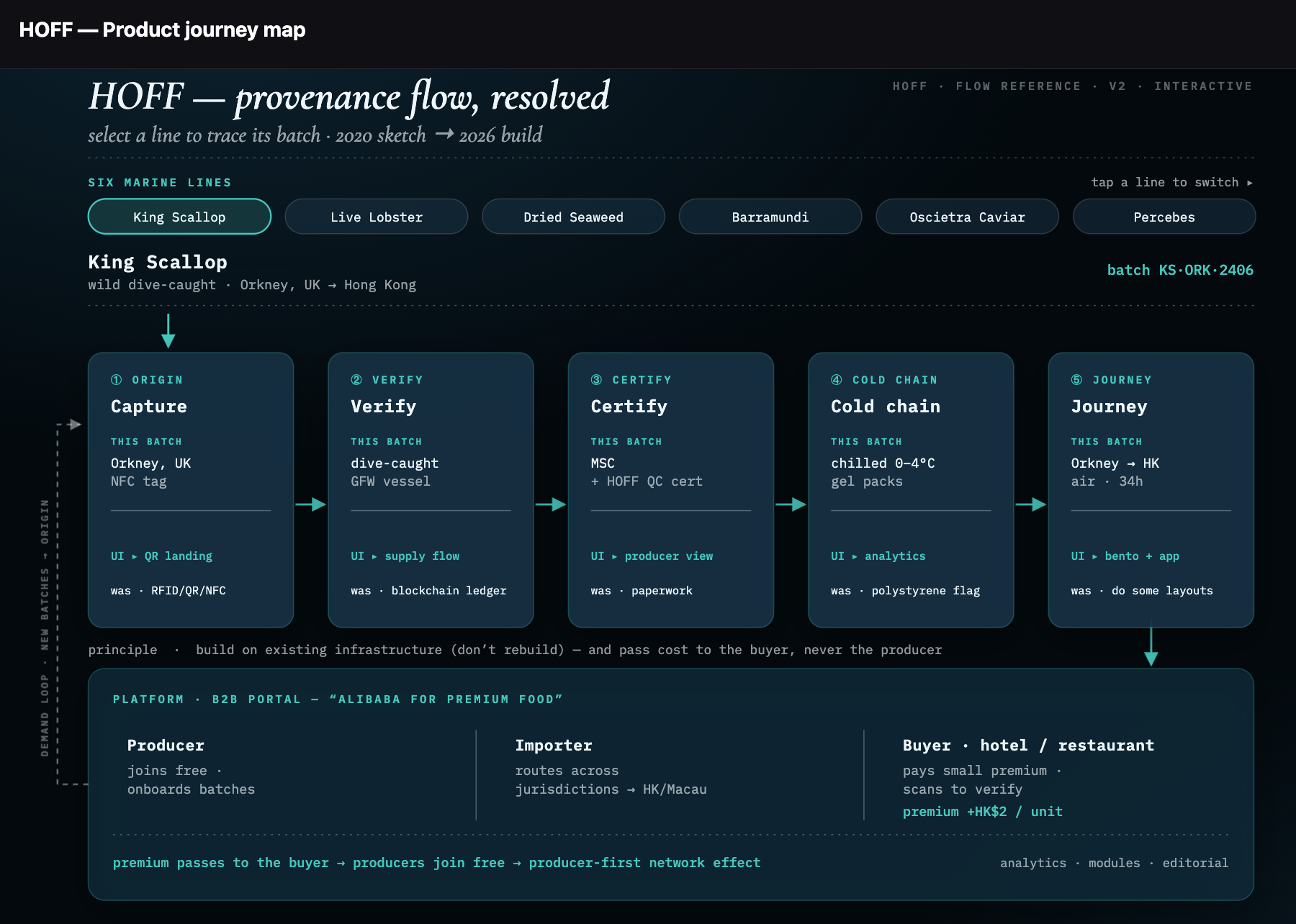
A transparency layer connecting boat-to-buyer events, storage temperature logs, and handler chains into a single timeline view tuned for non-technical buyers.
Key Decisions
Timeline-First Interface
Not a checklist or dashboard. A narrative timeline from boat to table, where each touch point is documented and verifiable.
Why: Buyers want to tell a story to their customers: 'This fish left the boat on Tuesday at 6am, arrived at the ice plant by 8am (stayed ≤-18°C)…' A timeline tells a story; a checklist is just data.
Incentive Alignment Across Chain
Each participant (boat crew, ice plant, distributor, retailer) benefits from documenting their touch point correctly. Wrong data = lost provenance claim = lost premium.
Why: Without incentive alignment, participants skip documentation or falsify records. I built the system so honest documentation is the path of least resistance.
Provenance as Brand Signal
Every restaurant/retailer can share the full timeline with customers via QR code. No gatekeeping data.
Why: When restaurants can prove their claims, they attract premium customers. Visibility isn't a risk — it's their marketing channel.
I mapped the entire supply chain — visited boats, ice plants, wholesalers, retailers, restaurants. Identified exactly where data got lost. Designed touch points where documentation happens naturally (boat crew already logs catch; I just made that log digital + verifiable).